Models / DeepSeek V4.1 Flash

DeepSeek V4.1 Flash

MoE workstation

552B total, 8B active at prefill / 16B at decode (MoE: 1 shared + 384 routed experts, 6 routed active per token). First widely deployed release on the Causal Encoder-Decoder (CED) architecture - a 40-layer transformer split into a 20-layer causal encoder and a 20-layer decoder, replacing the decoder-only stack of V4. FP8 safetensors on the main branch (48 shards, 510GB).

  • Context: 1M native, with multimodal (text + image) input. CSA2 sparse attention; KV cache is FP4 at roughly 890 bytes per token, so a full 1M-context cache stays under 1GB - weights, not context, set the rig floor.

Announced 2026-09-09, live on the DeepSeek API as deepseek-flash with peak/off-peak pricing ($0.30/$1.20 peak per 1M in/out; off-peak half; cache-hit $0.006/$0.003). From 2026-09-14 04:00 UTC the deepseek-v4-pro alias routes to V4.1-Flash at Flash rates until V4.1-Pro launches. DeepSeek’s tech report puts the instruct model (max reasoning effort) at GPQA-Diamond 90.9, Codeforces 3471, Terminal-Bench 2.1 90.6, with Humanity’s Last Exam 36.8 and Terminal-Bench 4.0 31.2 - all vendor-reported pending independent evals.

The full comparison table. DeepSeek’s numbers put V4.1-Flash at the top of the agentic rows against the frontier set it cites: Terminal-Bench 2.1 90.6 (V4-Pro 0813: 87.9, GPT-5.6-Sol 88.8, Claude Opus 5 89.1), DeepSWE v1.1 74.2 (Sol: 73.0, Opus 5: 74.0), CyberGym 88.1, HLE with tools 63.9, and Automation-Bench 54.8. It gives up ground on GPQA-Diamond (90.9 vs Opus 5’s 93.4 and Sol’s 94.1) and NL2Repo-Bench (65.4 vs Opus 5’s 75.3). Every figure in the table is DeepSeek’s own reported number for every model shown - vendor-reported, pending independent replication.
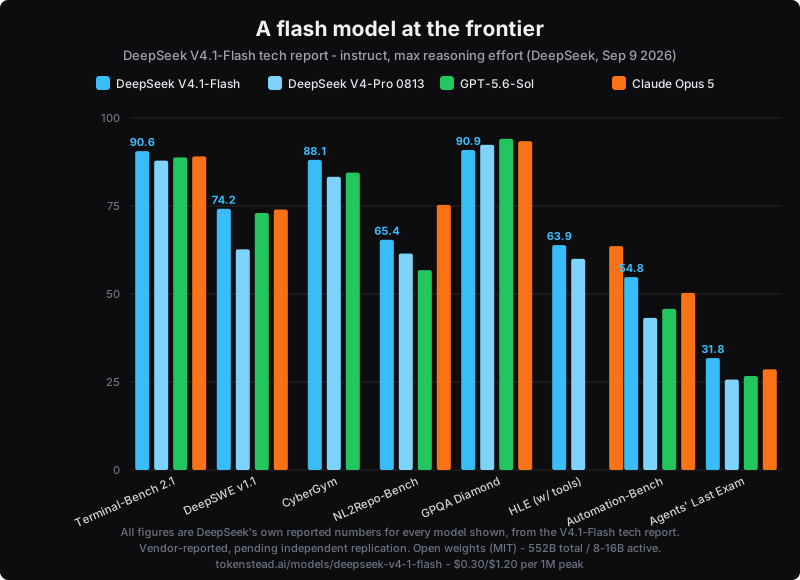
DeepSeek V4.1-Flash vs V4-Pro 0813, GPT-5.6-Sol, and Claude Opus 5 across eight benchmarks from DeepSeek's tech report: V4.1-Flash tops Terminal-Bench 2.1 (90.6), DeepSWE v1.1 (74.2), CyberGym (88.1), HLE with tools (63.9), and Automation-Bench (54.8).

Open weights are live on HuggingFace at deepseek-ai/DeepSeek-V4.1-Flash - FP8 safetensors on the main branch (48 shards, ~510GB), MIT license.

  • Local run: 4-bit quants land in the ~250GB range, so the target rig is 256GB+ unified memory (stacked DGX Sparks or a 512GB Mac-class box) - beyond a 128GB Spark. The model card ships an inference/ folder for weight conversion; community quants exist in the llama.cpp, Ollama, and LM Studio ecosystems. First measured datapoint on the stacked-Spark shape: a community build (2026-09-11) runs V4.1 Flash across 3x DGX Spark 128GB (384GB unified, SGLang TP=3 EP=3) at 37.9 tok/s single-stream decode, with the full setup scripts published; a UI video posted the day before shows the same rig shape at ~28-37 tok/s in a thinking-mode chat.

1017 checkpoint (2026-10-17): a post-training refresh of this model, same architecture and same price. Weights live at deepseek-ai/DeepSeek-V4.1-Flash-1017 (MIT, fp8), OpenRouter serves it as the first provider route at the same $0.15/$0.60 per 1M off-peak. DeepSeek’s table shows the reasoning quality moving up across the agentic rows: Terminal-Bench 4.0 31.2 to 42.3, DeepSWE v1.1 74.2 to 77.0, ProgramBench 20.3 to 29.1, Automation-Bench 54.8 to 60.5, Agents’ Last Exam 31.8 to 35.4, Apex 72.1, NL2Repo 68.2, HLE 42.6 (44.0 text-only). The release claims shorter outputs and faster task completion, a performance-cost Pareto improvement; the Search and Fetch server-side tools are free until November 1, 2026 (per-request billing starts then). A user-measured datapoint on the new checkpoint: ~246 tok/s in an agentic harness session at 98% cache hit (2026-10-17).

Supersedes V4 Flash 0731 in the flash tier; V4-Pro routes to it from 2026-09-14. The deepseek-flash API name and legacy deepseek-v4-flash aliases now serve the 1017 checkpoint at Flash rates.

coding reasoning agentic vision
Parameters
552.0B
Context
1000k
License
mit
Developer
DeepSeek
Origin
🇨🇳 China
Released
Sep 2026

What people are building with DeepSeek V4.1 Flash

Real demos from X

Launch post: DeepSeek V4.1 Flash, 8B active prefill / 16B decode on the CED architecture, 1M context, MIT weights View on X →

Day-zero subscription support: OpenCode Go ships V4.1 Flash on launch day with a 4x usage promo for the first 72 hours View on X →

Stacked Sparks, measured: V4.1 Flash split across 3x DGX Spark 128GB, live counter at ~28-37 tok/s with thinking mode on View on X →

Spark stacks roundup: which models run on 1x through 4x DGX Sparks, with measured recipes published for each build View on X →

Benchmark scores

Vendor-reported - from the developer's own model card / tech report

Agents' Last Exam
35.4
Automation-Bench
60.5
BabyVision
92.5
Chartography
83.0
CyberGym
88.1
DeepSWE
77.0
ExploitGym
15.3
GPQA-Diamond
90.9
HLE
42.6
HLE (w/ tools)
63.9
MathArena Apex
65.6
NL2Repo-Bench
68.2
ProgramBench
29.1
SEC-Bench Pro
62.8
Terminal-Bench 2.1
90.6
Terminal-Bench 3.0
30.0
Terminal-Bench 4.0
42.3
ZeroBench
51.0

Vendor-reported - from the developer's own model card / tech report

Ran this model on your own hardware? Join free and add your measured tok/s to the community numbers.

Score per dollar

4500 pts per $/M input

general_score (90) divided by cheapest input price ($0.02/M). Higher is better value. See live pricing.

Related models

Guides covering DeepSeek V4.1 Flash

Save your hardware and every model page answers the real question: will it run on your machine, and how fast?

Join free - save your rig →

Run it locally

Per-quant memory needs and a static "can you run it?" reference - no rig entry required

NVFP4
260.0GB 265.0GB min 290.0GB rec
NVIDIA FP4 - Blackwell or Apple MLX, near-lossless
FP8
510.3GB 515.0GB min 560.0GB rec
Quantized build

The reference hardware

Schematic of the NVIDIA Jetson Orin NX 16GB reference rig - 16GB unified memory, 102 GB/s aggregate bandwidth
Schematic of the Jetson AGX Orin 64GB reference rig - 64GB unified memory, 204 GB/s aggregate bandwidth
Schematic of the Single GTX 1080 Ti (11GB) reference rig - 11GB VRAM, 484 GB/s aggregate bandwidth
Schematic of the Single RTX 4090 (24GB) reference rig - 24GB VRAM, 1008 GB/s aggregate bandwidth
Schematic of the Single RTX 5090 (32GB) reference rig - 32GB VRAM, 1792 GB/s aggregate bandwidth
Schematic of the RTX PRO 6000 Blackwell (96GB) reference rig - 96GB VRAM, 1792 GB/s aggregate bandwidth
Schematic of the 2x RTX 3090 (48GB) reference rig - 48GB VRAM, 1872 GB/s aggregate bandwidth
Schematic of the 2x RTX 5090 (64GB) reference rig - 64GB VRAM, 3584 GB/s aggregate bandwidth
Schematic of the 4x RTX 4090 (96GB) reference rig - 96GB VRAM, 4032 GB/s aggregate bandwidth
Schematic of the 4x RTX 5090 (128GB) reference rig - 128GB VRAM, 7168 GB/s aggregate bandwidth
Schematic of the 8x RTX 3090 rack (192GB) reference rig - 192GB VRAM, 7489 GB/s aggregate bandwidth
Schematic of the AMD Instinct MI300X (192GB) reference rig - 192GB VRAM, 5324 GB/s aggregate bandwidth
Schematic of the 4x H100 80GB (320GB) reference rig - 320GB VRAM, 13400 GB/s aggregate bandwidth
Schematic of the MacBook Pro M5 Max 128GB reference rig - 128GB unified memory, 614 GB/s aggregate bandwidth
Schematic of the Ryzen AI Max+ 395 128GB reference rig - 128GB unified memory, 256 GB/s aggregate bandwidth
Schematic of the Mac Studio M4 Ultra 192GB reference rig - 192GB unified memory, 1092 GB/s aggregate bandwidth
Schematic of the DGX Spark 128GB unified reference rig - 128GB unified memory, 273 GB/s aggregate bandwidth
Schematic of the NVIDIA DGX Station 748GB reference rig - 748GB unified memory, 8000 GB/s aggregate bandwidth
Schematic of the Mac Studio M4 Ultra 512GB reference rig - 512GB unified memory, 1092 GB/s aggregate bandwidth
Schematic of the Dual EPYC 9004 + 768GB DDR5-4800 reference rig - 768GB unified memory, 460 GB/s aggregate bandwidth
Schematic of the Epyc + 512GB DDR4-3200 + 2x RTX 3090 reference rig - 560GB unified memory, 204 GB/s aggregate bandwidth
Schematic of the Epyc + 512GB DDR4-2400 + 2x RTX 3090 reference rig - 560GB unified memory, 153 GB/s aggregate bandwidth

22 reference configs, drawn in-house. Scroll for more.

Can you run it? - reference rigs

Rig NVFP4 FP8
NVIDIA Jetson Orin NX 16GB no -> cloud no -> cloud
Jetson AGX Orin 64GB no -> cloud no -> cloud
Single GTX 1080 Ti (11GB) no -> cloud no -> cloud
Single RTX 4090 (24GB) no -> cloud no -> cloud
Single RTX 5090 (32GB) no -> cloud no -> cloud
RTX PRO 6000 Blackwell (96GB) no -> cloud no -> cloud
2x RTX 3090 (48GB) no -> cloud no -> cloud
2x RTX 5090 (64GB) no -> cloud no -> cloud
4x RTX 4090 (96GB) no -> cloud no -> cloud
4x RTX 5090 (128GB) no -> cloud no -> cloud
8x RTX 3090 rack (192GB) no -> cloud no -> cloud
AMD Instinct MI300X (192GB) no -> cloud no -> cloud
4x H100 80GB (320GB) no -> cloud offload
MacBook Pro M5 Max 128GB no -> cloud no -> cloud
Ryzen AI Max+ 395 128GB no -> cloud no -> cloud
Mac Studio M4 Ultra 192GB no -> cloud no -> cloud
DGX Spark 128GB unified no -> cloud no -> cloud
NVIDIA DGX Station 748GB no -> cloud fast 297.4t/s
Mac Studio M4 Ultra 512GB fast 86.9t/s no -> cloud
Dual EPYC 9004 + 768GB DDR5-4800 no -> cloud ok 17.1t/s
Epyc + 512GB DDR4-3200 + 2x RTX 3090 no -> cloud slow 7.6t/s
Epyc + 512GB DDR4-2400 + 2x RTX 3090 no -> cloud slow 5.7t/s

Fit tiers use the same will-it-run logic as the rig finder. For comfortable fits, the badge reflects decode speed: fast >=20 t/s, ok 8-20 t/s, slow <8 t/s. t/s is a bandwidth estimate, not a measured benchmark.

Download options

NVFP4 community
260.0GB dl 265.0GB min 290.0GB rec
REC RAM vs largest quant
~260GB NVFP4 4-bit weights (community build for vLLM/TensorRT; 485B x 0.5B + block scales) + overhead + KV cache; ~265GB total memory. GGUF builds not yet published - the NVFP4 repo is the only 4-bit option so far
FP8 official
510.3GB dl 515.0GB min 560.0GB rec
REC RAM vs largest quant
510.3GB FP8 safetensors (48 shards, official main branch) + overhead + KV cache; ~515GB total memory - multi-node class

Or run it in the cloud

Live per-provider pricing, throughput and uptime - refreshed about 18 hours ago via OpenRouter. Click a column to sort.

Provider Type Input $/M Output $/M Cache $/M Tok/s Latency Uptime Value
OpenInference
API 0.02 1.00 0.015 - - 100.00% best uptime
Baidu
API 0.05 0.21 0.001 - - 100.00%
Relace
API 0.07 0.50 0.008 - - 100.00%
Decart
API 0.09 0.18 0.018 - - 100.00%
Sail Research
API 0.09 0.25 0.006 - - 100.00%
InferenceNet
API 0.10 0.72 0.008 - - 100.00%
AtlasCloud
API 0.14 0.54 0.014 - - 100.00%
StreamLake
API 0.15 0.59 0.003 - - 100.00%
CoreWeave
API 0.15 0.65 0.002 - - 100.00%
DigitalOcean
API 0.16 0.66 0.006 - - 100.00%
ModelRun
API 0.17 0.67 0.006 - - 100.00%
GMICloud
API 0.18 0.72 0.004 - - 100.00%
Novita
API 0.20 0.78 0.004 - - 100.00%
Mancer 2
API 0.20 1.00 0.015 - - 100.00%
Phala
API 0.21 0.84 0.004 - - 100.00%
Wafer
API 0.22 0.65 0.012 - - 100.00%
Makora
API 0.26 1.17 0.006 - - 100.00%
Crusoe
API 0.29 1.20 0.007 - - 100.00%
Nebius
API 0.30 1.20 0.010 - - 100.00%
API 0.30 1.20 0.030 - - 100.00%
SiliconFlow
API 0.30 1.20 0.006 - - 100.00%
Together
API 0.30 1.20 0.006 - - 100.00%
Parasail
API 0.30 1.20 0.006 - - 100.00%
Venice
API 0.30 1.20 0.008 - - 100.00%
Cohere
API 0.30 1.20 0.003 - - 100.00%
PrimeIntellect
API 0.30 1.20 0.006 - - 100.00%
Google
API 0.30 1.20 0.030 - - 100.00%
Alibaba
API 0.33 1.32 0.033 - - 100.00%
Fireworks
API 0.45 1.80 0.009 - - 100.00%
Morph
API 0.48 0.60 0.019 - - 100.00%
BaseTen
API 0.60 2.40 0.014 - - 100.00%
Reka risky
API 0.10 0.84 0.007 - - 91.65%
DeepInfra avoid
API 0.21 0.63 0.006 - - 0.00%
Sub - - - - - - $10.00/mo Go ($5 first month)

Default order: throughput among 95%+ uptime providers, then latency; subscriptions last. Sort by any column. Subscription rows show $/mo in the Value column - per-token columns are "-". Affiliate links are marked sponsored / nofollow. Confirm current pricing on the provider's site before committing.

Detailed API pricing page + JSON endpoint →

See who runs DeepSeek in production →

PRICE HISTORY

Inference cost over time

Data accumulates from the first daily sync - longer ranges populate over time. Prices come from OpenRouter snapshots, not a historical API.

Loading price history...